
Audit-Ready Delivery Approach
Regulated delivery through coherent evidence chains. Enable confident release decisions by maintaining traceability from intent to evidence—supporting regulatory expectations while remaining pragmatic for real engineering teams.

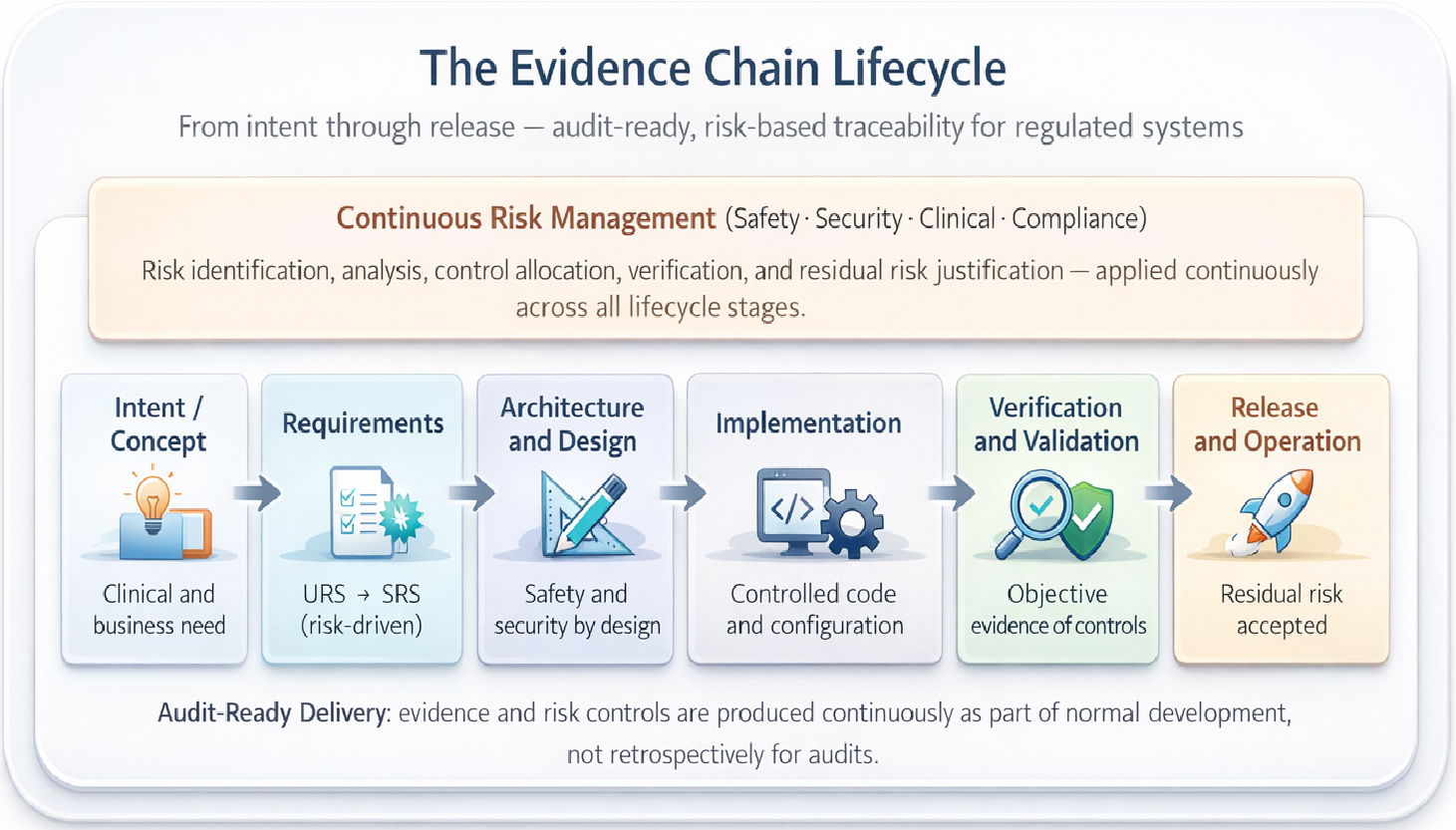
The Evidence Chain Lifecycle
From intent through release: how regulated systems build and maintain coherent traceability.
Risk & Compliance Integration
Risk controls are not bolt-on documents—they’re engineered into requirements, design, and verification from the start.
Core Principle
Risk is designed in, not added at the end. Risk controls live in requirements, design, and verification— generating evidence as you deliver.
What This Prevents
• Last-minute remediation
• Missing justifications
• Uncontrolled changes
• Weak audit narratives
What You Get
• Clear definitions of intended use and system boundaries
• Consistent linkage between hazards, controls, and verification evidence
• Design rationale captured as decisions are made
• Evidence packaging that supports confident release decisions
Result: faster delivery, clearer audit narratives, lower rework.
Traceability & Design Controls
Making traceability an engineering property rather than a compliance burden.
Requirements
Testable, unambiguous, and tied to acceptance criteria—each with a clear path to design and verification.
Risk Controls
Explicitly mapped: where the control lives and how it is verified. No hidden dependencies.
Verification
Evidence exists to prove controls and requirements work—not just to chase coverage numbers.
CI/CD Quality Gates Aligned to Regulated Expectations
Automation strengthens evidence quality and repeatability without adding bureaucracy.
Quality Gates (Examples)
• Controlled change process and peer review
• Build provenance and repeatability
• Automated test execution and evidence capture
• Security checks appropriate to risk
• Release readiness checklist linked to traceability
What “Good” Looks Like
A release can be explained quickly: what changed, why it changed, which risks were affected, and what evidence supports acceptance.